The four types of human behaviour
Main ideas of Thomas Erikson’s book
Reading time: about 5 minutes.
Recently I stumbled upon a book by Thomas Erikson “Surrounded by Idiots - The four types of human behaviour” which sorts human behaviour into four groups: the reds, the yellows, the greens and the blues. Is that all it takes to understand how people behave and communicate? A generalisation into four colours? Curious indeed!
The Reds
Let’s define the colours first. Who are the “reds”? Are they the tourists on a Spanish beach with glowing red skin after lying in the blazing sun with little or no sun protection? Or are they the people whose faces turn dark red when they get even slightly angry? Or are they the kind of people who order their food “extra, extra spicy” so they can feel the flames of the chilli on their breath?
According to Thomas Erikson, reds are visionary, task-oriented and proactive. They tend to see everything as a competition, whether it is the nicest garden in a German village, the shiniest car on the street or the highest score on Duolingo. They need to compete. Typical red behaviour includes a firm handshake, a loud voice, direct eye contact and controlling gestures. They are decisive and powerful, and they make others step aside. Since they are visionaries, they are interested in the future. Can you think of someone in your personal life? If you want to communicate with a red, skip the small talk, because they do not care for it. They want to hear your proposal and expect you to take a clear stand.
The Yellows
Who are the “yellows”? Are they the people sipping yellow cocktails with little umbrellas? Or are they the ones who love cheese and order Käsespätzle at the Munich Oktoberfest?
Yellows are relationship-oriented and tactile. They show friendly eye contact, use expressive gestures and often come a little too close to others physically. They are optimistic, usually too optimistic. They think they can manage a dozen meetings a day or take on more than they can handle. They love their positive energy and avoid bad moods and negative vibes. They like to propose new things, but as soon as those things are no longer new and become familiar, they lose interest. Their working style is not task-oriented. They often start several things at the same time but never finish any of them. If you expect results from them, you not only need to prepare some personal anecdotes and use strong expressions like “state of the art”, “never before used” and “cutting edge” (as Thomas Erikson’s book suggests), but you also have to coordinate all appointments properly and clearly specify the agenda and the outcome of each meeting. But do not try to control them. They hate it, and it paralyses them. Can you think of some people who show this tendency?
The Greens
The “vegetarians” and the “organic-food fans”. Pardon me, I mean the “greens”: what are they like? Do they eat lots of salad and green vegetables and constantly buy organic products?
Even though they make up the bulk of the population, not all of them are vegetarians 😉. These personalities are typically interested in relationships but are mostly introverts. They do their tasks, they listen, they prioritise group harmony over personal spotlights, and they like to be at peace with the world. They absolutely hate negative criticism in front of a group and prefer a planned future. Change does not excite them, and they need time to adapt to it. So if you are a red or yellow manager and you want your group of greens to adapt to proposed changes, you need to give a clear structure, show what needs to be done and practise patience.
The Blues
Are the blues like the music genre, then? No, they are task-oriented and very introverted.
They approach life through a lens of logic, data and thorough analysis. If a red wants to win the race and a yellow one wants to make friends with everyone along the way, a blue wants to make sure the car engine is built to exact ISO standards and that every single nut and bolt is in the right place. They are meticulous and detail-oriented, and they question everything. While a yellow will throw out words like “cutting-edge” and “revolutionary”, a blue asks: “Where is the data? Can you prove it? And did you check page 42 of the compliance manual?” They love structure, facts, rules and accuracy. Spontaneous changes or sloppy, half-baked ideas give them a mini heart attack. They need time to research, verify and double-check before making a move. If you want to communicate effectively with a blue, forget emotional appeals and dramatic storytelling. Come prepared with spreadsheets, well-documented facts and a structured plan. Give them space and time to think things through, and respect their need for quality and precision.
Conclusion
Interesting, isn’t it? Which category do you think you belong to, and why do you think so? According to the author, most people are a mix of two colours, and some of three. It also depends on the situation. It is a broad generalisation, but it can help you understand which communication style to choose in order to create a win-win situation. The following graphic summarizes the colours.
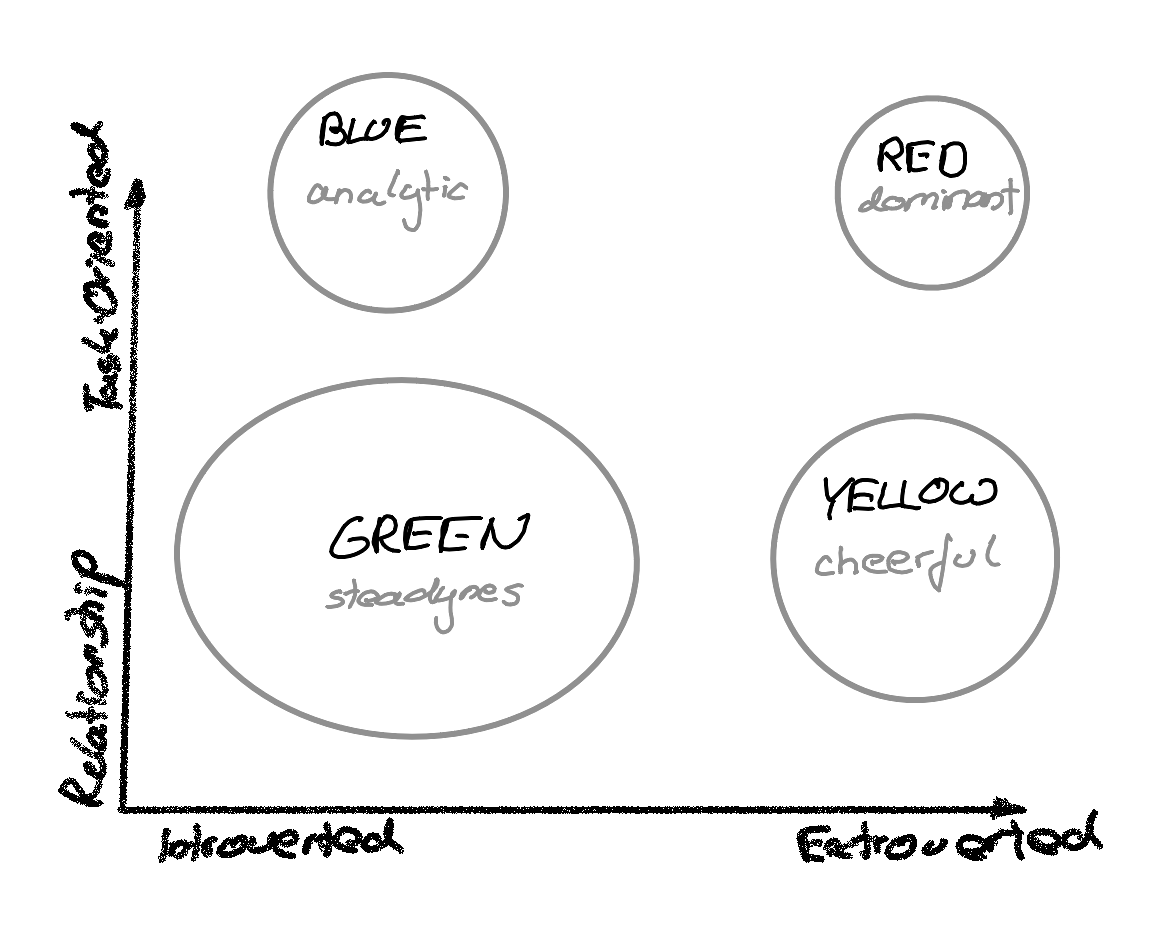
Blues and reds are task-oriented while greens and yellows are more relationship-oriented. Blues and greens are mostly introverted while reds and yellows are extroverted. If you feel like you don't understand someone next time, this book might just help you a lot. Have fun reading it.
If you want to share your thoughts, feel free to write me an email: lucas.hoeppler@gmail.com.